
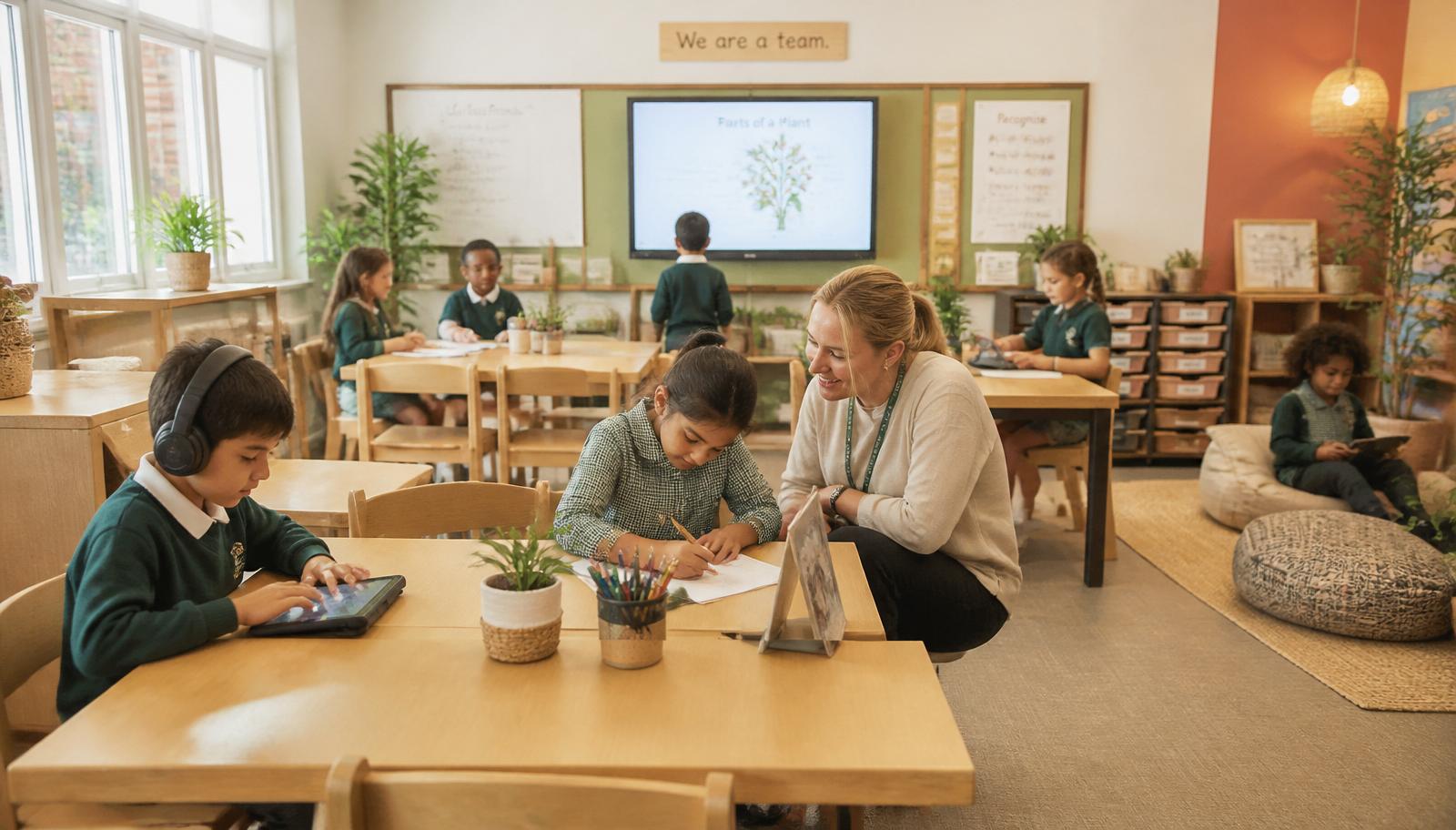
A neuro-inclusive classroom
Empowering every child to learn, communicate and thrive. Designed for autistic pupils and children with ADHD, dyslexia, dyspraxia, sensory processing differences and other neurodivergent profiles.
Calm, everyday support — for the whole classroom.
One in five children in UK classrooms is neurodivergent. CalmClass is a gentle, low-friction app that closes the loop between the child, their teacher, their parent and the SENCo.
Neurodivergent students (ADHD, autism, dyslexia, anxiety, sensory needs) aged 7–16, and the adults supporting them.
A gentle daily check-in, quiet 'help / break / overwhelmed' signals, calm lesson read-alouds, and a shared view for teachers, parents and SENCos.
A progressive web app that works on any phone, tablet or school Chromebook. No install friction, offline-friendly.
- Autistic pupils
- Children with ADHD
- Learners with dyslexia or dyspraxia
- Pupils with sensory processing differences
- Primary schools and Multi Academy Trusts
- SEND teams and Alternative Provision
Four silos. One child in the middle.
Neurodivergent pupils are more likely to be excluded, to miss school, and to leave education without the qualifications their ability would predict. The reasons families and SENCos cite are consistent — and small.
- Children can't signal 'I am overwhelmed' without drawing attention — so they mask, shut down, or leave the room.
- Teachers only find out something was wrong hours or days later, if at all.
- Parents get a one-line message at pickup and have no picture of the day.
- SENCos hold the plan, but see no live evidence of whether adjustments are working.
- Behaviour-tracking platforms are built for compliance, not for the child's inner state.
- Generic wellbeing apps aren't tied to the school day.
- SEND case-management systems serve SENCos, not students.
- Nothing sits with the child, in the moment, and quietly shares what happened with the adults who need to know.
"He'd been holding it in since maths. If I'd seen even a one-tap 'overwhelmed' at 11am, the whole afternoon would have looked different."

Giving every child a voice.
Discreet. Visual. Instantly understood.
Many children find it difficult to ask for help when they feel overwhelmed, anxious or overstimulated. Simple visual prompts let pupils communicate without drawing attention to themselves, and teachers respond in a timely and sensitive manner.
- I don't get it
- It's too much
- I need help
- I need a break
Pupil check-in on iPad

Tools that help children find calm.
Quick check-ins, guided breathing, gentle prompts.
Children complete short emotional and sensory check-ins throughout the day, helping them identify and communicate how they feel, and access strategies that work for them.
- Guided breathing exercises
- Calm-down activities
- Focus and visual timers
- Social stories
- Emotional vocabulary support
- Personalised coping strategies
Self-regulation tools. Pocket-ready, sensory-light.

Real-time insights, in one calm view.
Identify concerns earlier. Respond proactively.
A live wellbeing and support dashboard. Pupil status, alerts, regulation trends and AI-generated daily summaries.
Whole-school view, built for SENCOs and leaders.

A whole-school view of wellbeing.
Better-informed decisions. Better-allocated support.
- Early intervention indicators
- Attendance & wellbeing trends
- Behaviour pattern analysis
- EHCP evidence gathering
- Safeguarding support records
- Support planning documentation

Stronger partnerships with families.
One shared understanding of every child.
Parents access a secure view of their child's daily wellbeing check-ins, achievements, attendance, teacher observations and the support strategies being used in school, helping create consistency between home and classroom.
Family view. Designed for the pocket, built for the day.

Built for every learner.
Accessible by design
- Visual-first navigation
- Adjustable fonts and text sizes
- Colour-blind friendly design
- Screen reader compatibility
- Low sensory mode
- Predictable layouts
- Large touch-friendly controls
Secure & GDPR-ready
- GDPR-ready architecture
- Secure role-based permissions
- Protected pupil data
- Access controls for staff, parents and administrators
- Works on iPads, Chromebooks, laptops and mobile
- No app store downloads required
How CalmClass works in a day.
Following Ava, Year 5 — one child, one school day, four adults quietly kept in the loop.
- 08:45
Registration
Ava opens CalmClass on her school tablet. A soft check-in: how are you feeling? Her teacher sees the amber marker on the roster.
- 10:20
Maths
Ava is losing the thread. She taps Confused — no hand up, no attention. Her teacher gets a gentle prompt to check in at the next natural pause.
- 11:05
Break
She taps I need a break. The pre-agreed plan triggers: five minutes in the quiet corner. The SENCo sees the pattern building across the week.
- 13:10
Lesson catch-up
Today's science reading plays back with the calm read-aloud at 0.9× speed, with the paragraph she's on highlighted.
- 15:30
Home
Ava's mum sees: mood dipped mid-morning, one break taken, science read twice, teacher note 'good recovery after lunch'. No surprises at bedtime.
- Weekly
SENCo review
The SENCo exports Ava's PDF summary. Break requests are down 40% since the seat change — evidence for the next EHCP annual review.
Calm by default. One tap, always.
Calm by default
Muted palette, generous spacing, no red badges, no anxiety-spiking notifications.
One tap, always
Every core action for a student is a single tap. Reading load is deliberately low.
Consent and control
Parents opt in per child and can revoke access instantly. Students see what's shared.
No dark patterns
No streaks, no leaderboards, no engagement metrics pushed at children.
Works where schools are
A PWA on any device — offline-tolerant, installs in one tap.
Evidence, not compliance
Data serves the child's plan, not classroom control.
Measured outcomes
- Reduction in unplanned classroom exits and escalations
- Attendance — and specifically partial-day attendance — for tracked students
- Parent-reported confidence in understanding their child's school day
- SENCo-reported time-to-evidence for EHCP reviews
- Student-reported sense of being heard (short, age-appropriate survey)
Safeguarding & data protection
- UK GDPR compliant — full DPIA completed jointly with each school
- Row-level security: a parent can only ever see their own linked child
- No advertising, no third-party analytics on child-facing screens, no data sold
- Full data export and deletion on request, per child, in one click
- Safeguarding disclosures follow each school's existing policy

A 12-school pilot. 1,200 students. One shared evidence base.
We're seeking a partnership with the Neurodiversity Foundation for a 12-school pilot across the 2026–27 academic year, and to share the resulting evidence with schools, families and policymakers.
Start the conversation